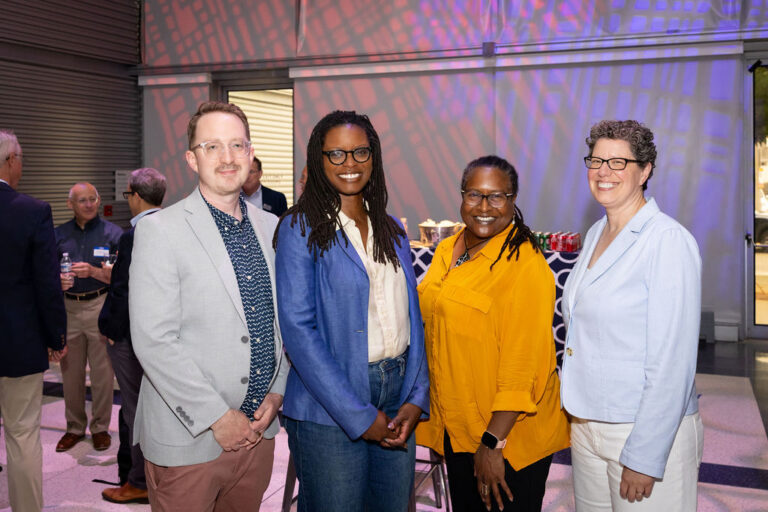

On July 15, we hosted a film screening of “Promises of the Revolution” at GBH Studios in Boston. This director’s commentary has been compiled and edited from two panel conversations held that day. Trajan Warren, who moderated the panel discussions, is a reporter with GBH’s Equity & Justice Unit. Steven Peters is the creative director of Smoke Sygnals. He is the director of “Promises of Freedom,” the first film in our series.
Trajan Warren (TW): How do these stories focusing on Black, Indigenous, LGBTQ+, women’s histories, how do they change our understanding of the American Revolution?
Steven Peters (SP): For me, it’s changed my understanding of the motivations of why. Why they would choose to fight in the Revolutionary War. Because I think that is what is so unique about all these different communities in the videos that we just saw, is the motivations.
And you start to understand that and say, oh, I get it. I understand why, as an Indigenous community that got screwed over in all of these different ways by both sides, would then decide to pick and choose, okay, you know what? We will go fight on this side.
And that, for me, has given me a much deeper appreciation for my community’s connection to the land and why I have to continue to have my home there, have my children there, and make those choices. Those conscious choices. It’s the motivations.
TW: Why was it important to tell this story about the American Revolution?
SP: I think the stories that I heard here today have felt like they’ve been pushed out of the history books. They’re really marginalized, the voices of these communities. And so I think even within our own communities, often they’re not as widely known as well.
Even as a kid, I remember being pushed into other places–we’d have to go to the Children’s Museum in Boston to see exhibits that reflected youth in our communities. And so now, when we’re given platforms like this to kind of share that voice, what I find is communities are like, “Great! Let’s tell it all.” And then you have to go back to them and say, well, we only have six minutes. I can’t fit all of this in six minutes. But they’re like, but I’ve been waiting for generations to say this.
This is the stuff that we get around our kitchen tables. But then when you go to school, you don’t see it. When you go into the museums, you don’t see it. You don’t see yourself reflected in television, in movies. We’re starting to build that platform. And for me, that’s what this was. It was to start to share those voices.

TW: What inspired your film?
SP: Early conversations that we had with Raeshma were interesting in that we talked a lot about the process that we were going to go through to engage the tribal communities. And, that we weren’t sure going into it what we wanted to talk about around the 250th.
I always go into [projects like this thinking] it’s not my place to interpret what our tribes want to say, but rather it’s a place where I want to sit back and listen and say, “well, what are you ready to share?”
And they wanted to talk about the petitions. What the Revolutionary War was about was nothing new to our tribal communities. We’d been doing it and raising our hands and saying, “we want this thing called freedom.” We’ve been asking for it, and we’re going to continue to ask for it. And we continue to today.
This is the stuff that we get around our kitchen tables. But then when you go to school, you don’t see it. When you go into the museums, you don’t see it. You don’t see yourself reflected in television, in movies. We’re starting to build that platform. And for me, that’s what this was. It was to start to share those voices.

TW: What were some ideas or scenes you couldn’t include in the final edit?
SP: It was narrowing down to what we would focus on. That’s the first thing that I noticed. I get that with every project that we go into. So, film is just one piece of the museum exhibits that we develop [through Smoke Sygnals]. But it’s an important piece because it’s how we get people to actually see, get the emotion, and feel like there’s a human connection to the stories that we’re telling.
So with this one here it was, well, what do we not share? Not as much as, what do we cut after we shoot? So we had to have a lot of conversations about what we wanted to focus on. There were a lot of other petitions that they wanted to discuss as well. There was a lot around the way that Mashpee was carved up and the land was lost. That was really important to them, and we had to make a conscious decision to say we couldn’t take the audience along with us to really unpack that. So it’s things like that that we had to kind of leave and let them know we’ll come back to it at another time.
TW: What do you hope the audience takes away from each of your films?
SP: I know for everyone that I talked with going into this, it was very important that the thoughts of why we fought in the Revolutionary War and what we were asking for have not fully been realized. And so they didn’t want anyone to walk away from this feeling as though “check mark, done.” Like, “let’s move on.” Rather, there’s been some progress, but there’s still a lot more to go to achieve what was being asked for in those original petitions, and that there will be new asks that are coming out as well.
So I hope people see that and say, there was an idea. It’s not fully been realized.
 TW: The series is titled “Promises of the Revolution.” What promise, would you say, remains the most urgent for the U.S. to fulfill?
SP: I think for us it is, again, always coming back to having the ability to preserve your culture on your land. The more I understand when I talk about my culture, the more I realize that my culture is the land. So, if the land changes and the landscape changes, and the plants and the people change within it, my connection to my culture changes as well, right? It’s the food. It’s the smells. It’s all of those things. And we’ve remained in that place. So we have that unique position of having never lost that connection to our land. And I see us continuing to raise our hand and saying, “allow us to have that ability to preserve ourselves in that capacity.” I think that’s what I see as the ideal.